Protect Our Kids : The Case for Zero-Tolerance Bullying and Hazing Policies.

Hazing and bullying have become an alarming threat in America's schools and athletic programs, leaving students and players mentally shaken and physically injured. These behaviors will not "toughen kids up" but rather destroy confidence, team culture and leave scars that can follow victims for years. This growing "tradition" doesn't have to remain a problem. With stronger oversight, tougher enforcement and stricter anti hazing policies, we can give educators and coaches the tools they need to protect young lives.
According to Leo Lim, in a US Bullying and Harassment Data Analysis Report, an analysis shown proves that as students go up a grade, bullying generally decreases. The analysis states that 26.9% of 6th graders are bullied, but also states that 10.4 percent of 11th graders have an experience of being bullied. Leo Lim stated that the extreme downward trend of the slope from 6th graders to 11th graders shows the importance of personal growth of individuals of what is right and what is wrong as they enter puberty. which is a crucial stage of life in the internal and external development of their bodies.
Figure 1 - The Decline in Bullying and Harassment as children get older.

The Springer Nature Leak, states that bullying and hazing are compared along the dimensions among aggressions, with intent to cause harm and distress, power imbalance, and reptation. 199 amazon workers took a survey on harassment as victims, or witnesses. The participants evaluated harassment as an act of aggression.
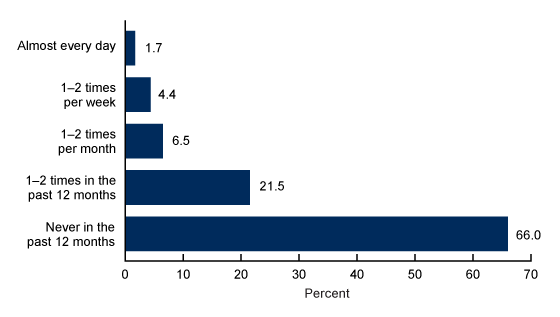
National Center for Health Statistics
So, what's the solution? How do we eliminate these behaviors?
The first step to lean into the right direction would be to enforce a stronger watch on our children in the locker room, the classroom, or the bathroom.
StopBullying.gov states the following
1. Enforce stricter policies and punishments
2. Presentations on harassment and what it can cause.
3. Discussions on how to report these behaviors.
4. Classroom meetings to talk about peer relation.
Is stopping hazing as easy as it sounds? Alisha Ebrahimji did a report on a football team and the coach stated that "Getting students to report hazing is challenging because the practice thrives on the desire to connect with others, belonging, and secrecy through what Lipkin's calls “the code of silence.” Stating that members of a group must keep quiet about any hazing activities, no matter how harmful abusive, or illegal they may be. Ultimately, if we try our best to eliminate hazing, she believes students still wont speak up about it. Another study shown says that these traditions build social bonds, and are social interactions, as well as others stating that kids need to "toughen up" and get used to it.
Even while some people insist that hazing and bullying are nothing more than harmless jokes an innocent rites of passage, the reality is far more serious-and far more dangerous. What many refuse to acknowledge is that these behaviors arent bonding traditions, but rather destroying young lives. If we get the right tools to our teachers, educators, and coaches, we can ultimately eliminate these actions.


Comments
Post a Comment