Universal Human Rights: Beyond America's Border
“We hold these truths to be self-evident, that all men are created equal, that they are endowed by their Creator with certain unalienable Rights, that among these are Life, Liberty, and the pursuit of Happiness.”
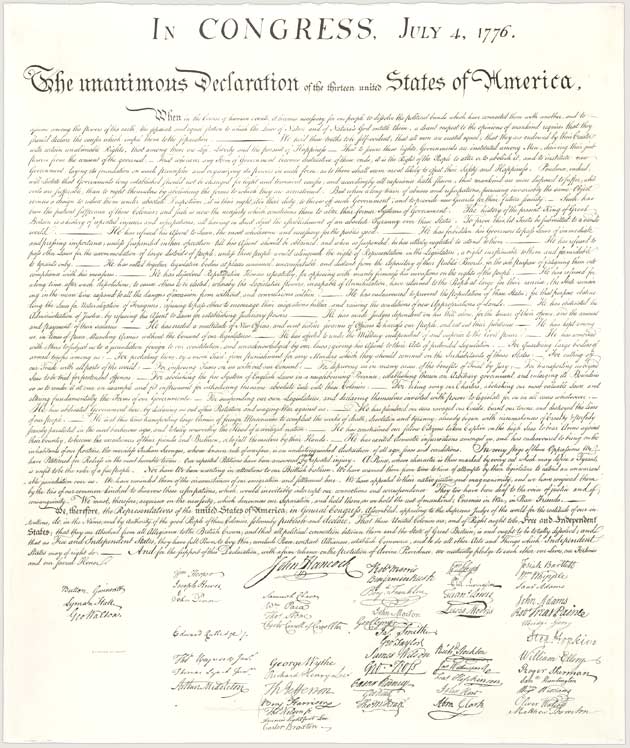
You
will recognize these words from the Declaration of Independence, written and
signed in 1776. This has been the mantra of American citizens and the
government since its founding. And in many ways, this mantra has spread to
every corner of the world, revealing the dignity not just of American citizens
but of men everywhere. The Declaration of Independence, with its assertion that
“all men are created equal,” is not merely a historical document but a
universal moral standard—one that demands application to all people, regardless
of race or nationality, if its ideals are to hold any true meaning.
The
Declaration of Independence was indeed formulated with the freedom of the American people specifically in mind. They desired separation from British
tyranny and sought to found a new country where its citizens could enjoy
freedom and equality. Thomas Paine, an American Founding Father, wrote a famous
pamphlet during the year of America’s foundation called Common Sense. In it,
Paine sought to teach “Americans to free themselves from prejudices and false
convictions, and to act in accordance with the dictates of reason.” With all
this in mind, some could argue that the Declaration of Independence is
meant solely for the American people. We have freedom because we fought for it,
and so we deserve it. But I believe this lesson ought to be taught to everyone,
not just to Americans. The citizens of Argentina, Africa, Guyana, and Spain, in short, all
countries, must adopt this mindset of equal dignity amongst mankind.
When
the demoralizing conflict of WWII finally ended, it was recognized that the
world was suffering greatly. Mankind had been deeply violated. In response, in
1946, representatives from America, China, Lebanon, the United Kingdom,
Australia, Chile, and France came together to formulate the document UDHR (Universal
Declaration of Human Rights). This document reiterates what the Declaration of
Independence recognized and upheld. “It was the first time countries agreed on
the freedoms and rights that deserve universal protection for every individual
to live their lives freely, equally, and in dignity.”
Going
back to the counterargument that the truths and human rights set down by the Declaration
of Independence are meant only for American citizens, I say again that this is
absurd. Many famous Americans also rejected such a mentality. Eleanor Roosevelt,
niece of President Roosevelt, played a large role in the process of the UDHR. As
the first international stateswoman, she pushed zealously for worldwide equality
of rights.

The UDHR lays out 30 core principles that serve as a global roadmap. Amongst them is Article 23, where it is stated that “1) Everyone has the right to work, to free choice of employment, to just and favorable conditions of work, and to protection against unemployment. 2) Everyone, without any discrimination, has the right to equal pay for equal work. 3) Everyone who works has the right to just and favorable remuneration, ensuring for himself and his family an existence worthy of human dignity, and supplemented, if necessary, by other means of social protection.” It is made clear that poverty, economic division/inequality between neighbors, and the unfair distribution of goods and services are violations of universal human rights.
So
many people throughout the world suffer from poverty and, consequently, from
shame. A study was done by the Department of Psychology and Human Developmental Sciences, where they “focused on poverty-related shame, which is a negative
evaluation of the core self, triggered by the economic conditions of one's
impoverished family.” Brother will complain against brother that “he did this
to himself.” By making poor economic choices, the accumulation of debt, or the lack
of employment, one condemns oneself to a life of poverty and only has oneself
to blame. Nevertheless, no matter the cause of failure to meet society's
expectations, one’s innate dignity and rights still exist. In fact, it is this
exact truth that all men are created equal that summons others of means and
substance to reach out a hand and help their poor neighbor. Yet, instead, we
live in a comparative and opposing world where the wealthy and the needy live
side-by-side, the former blatantly ignoring the unfortunate latter. In the study mentioned above, a comparative environment was assessed at a certain Chinese
university. Statements such as “At my university, students often compare each
other's household economic situation” or “At my university, students generally
believe that those with a bad household economic situation are not as good as
those from wealthier families” were presented to the students, where they would
rate each one on a scale of 1-5. The outcome was an 85% variance in reliability,
leaving only 15% to measurement error. This proves that not only are human
rights and man’s dignity not being upheld, but that neighbor is divided from neighbor
because of poverty and economic injustices.

Allida Mae Black quotes Eleanor Roosevelt in her book Courage in a Dangerous World - “Where,
after all, do universal human rights begin? In small places, close to home - so
close and so small that they cannot be seen on any maps of the world ... Such
are the places where every man, woman, and child seeks equal justice, equal
opportunity, equal dignity without discrimination. Unless these rights have
meaning there, they have little meaning anywhere.” As Americans, we are called to
uphold the dignity of every human person, of every nation, for we are under God,
indivisible, deserving of liberty and justice.


Comments
Post a Comment